
This is the latest from our correspondent, Greg Moats.
-- A little Auld Lang Syne for today’s hand gunners
This is the time of year for “Auld Lang Syne”. Translated variously as “days gone by” or “for the sake of old times,” it serves as a call to remember and to appreciate our past.
The need to appreciate days gone by was driven home to me the other day when I saw a header-photo for an on-line article depicting a pistol being held in what Massad Ayoob has christened the “wedge grip.” Handgun shooters can be a condescending lot and a brouhaha immediately erupted regarding the “incorrect” location of the pictured support hand’s index finger on the handgun. Comments eventually ventured into “correct” thumb placement while gripping a handgun and ended with contentious opinions about the “correct” use of the slide stop lever. None of the comments led me to believe that any of those commenting had ever been captain of their high school debate team but I’m pretty sure that a few of them had been in bar fights.
It seemed appropriate that as we close out one year and open another, that we stop “for the sake of old times” to see where we’ve come from in order to give an Auld Lang Syne look at some of the techniques that we took for granted but many now consider “incorrect.”
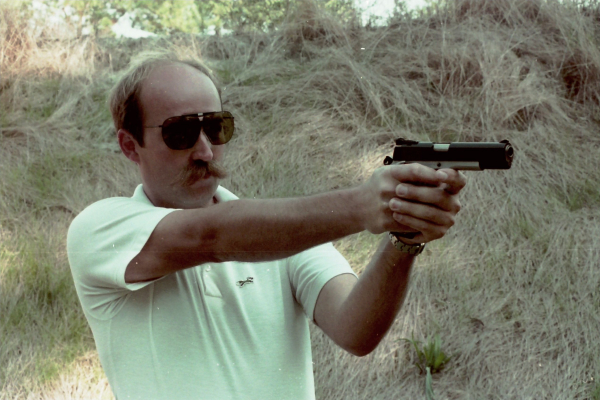
Support Hand Index Finger Placement
Most contemporary instructors teach that the “correct” location for the support hand index finger is underneath the trigger guard (henceforth referred to as the “wrap around” technique) and there are some good physiological reasons that support that belief. With a “thumbs forward” grip, the wrist is locked with the support hand angled down at almost a 45-degree angle. This allows the support hand Index finger to wrap around the pistol grip and be underneath the trigger finger providing a downward torquing pressure at the base of the pistol grip, thus helping to mitigate muzzle rise. While this is currently considered the “correct” way to grip a handgun by many, it hasn’t always been so.
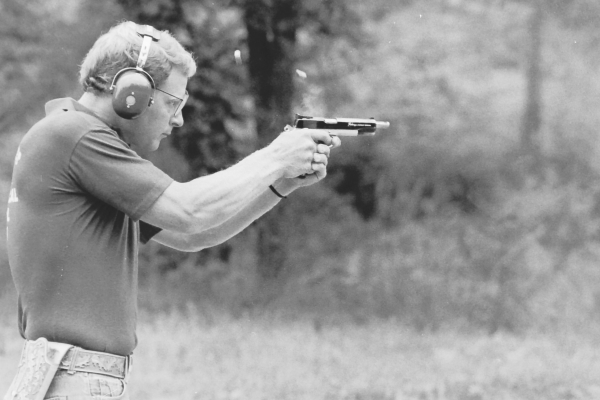
I had the good fortune to attend the first class that was ever held at the Chapman Academy. It was August of 1978 and was the first formal handgun instruction outside of the military that I ever received. Ray Chapman taught a grip that differed significantly from the one described above and also the grip taught at the time by Jeff Cooper. In those days almost all “practical” shooting was conducted with the ubiquitous 1911 and Cooper taught that the shooter’s strong-hand thumb would remain on top of the slide safety after disengaging it. This kept the thumb relatively high and kept the safety from being unintentionally re-engaged by the thumb during recoil which was possible when firing the gun with the thumb underneath the safety. These were the fledgling days of the beavertail grip safety and no one had yet conceived of a “memory bump” which is now a standard feature on grip safeties and ensures that even a poor grip will be sufficient to depress the safety and allow the gun to fire. Keeping the thumb on top of the safety, a la Cooper’s method, significantly increased the chances that the grip safety wouldn’t be pushed in far enough to disengage. Cooper solved this dilemma by pinning the grip safety down which totally eliminated its function.
Chapman’s method deviated from Cooper’s in that the strong hand thumb would “swipe” off the slide safety and continue to move downward until it was underneath the slide safety. A shooter’s grip will be stronger with the thumb low as if making a fist than it will be with the thumb high as if giving a “thumbs up” sign. This ensured that the grip safety would be positively disengaged. To keep the thumb from inadvertently re-engaging the slide safety during recoil, Ray locked the support hand thumb over the top of the strong hand thumb, forcing it to stay in place. With the popular, contemporary “thumbs forward” grip, the support hand thumb is directly underneath the strong hand thumb, with the Chapman method, this is reversed. The end effect of Chapman’s method is that the entire support hand grips the handgun slightly higher than the “thumbs forward” grip and places the support hand index finger on the same plane as the trigger finger. So located it can naturally wrap around the front of the trigger guard, assuming that the shooter has reasonably large hands and sufficiently long fingers. Placing the support hand index finger on the front of the trigger guard (henceforth referred to as “finger forward” technique) instead of lowering the hand by one digit and wrapping it under the trigger guard results in the support hand being more or less parallel with the ground instead of at the previously mentioned 45-degree angle. While this eliminates the torquing effect on the base of the grip provided by the “thumbs forward” grip, it raises the support hand grasp on the gun and essentially results in a slightly lowered bore axis. Enough to matter? Probably not except when shooting one of the currently popular sub-compact semi-autos. If the shooter has a notably bladed stance and/or shoots with their support side shoulder ahead of their strong side shoulder, this essentially lengthens their support arm and makes the “finger forward” technique more comfortable than if attempting to do so from an Isosceles stance. The same effect can be accomplished by bending both arms as Ross Seyfried championed.
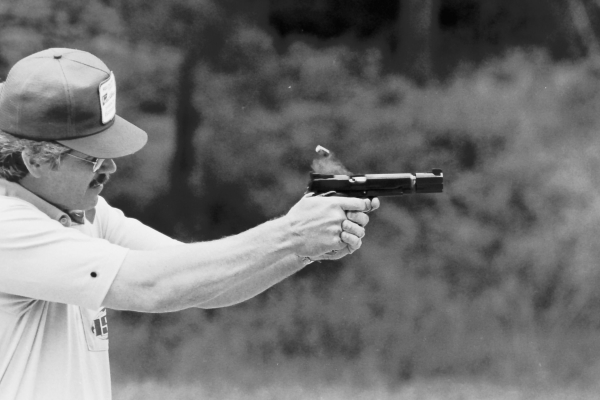
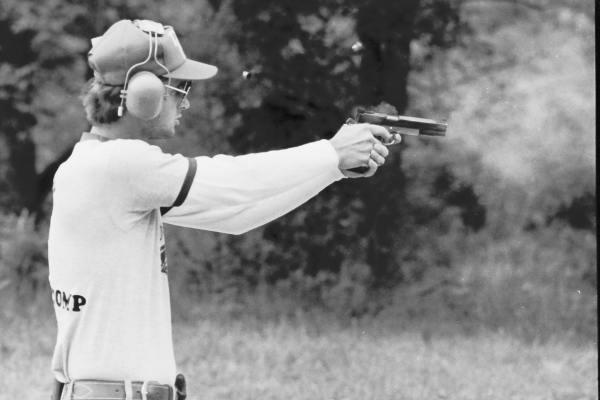
It’s worth noting that in the late 1970’s and early 80’s almost ALL of the top IPSC and Bianchi Cup competitors utilized the “finger forward” technique. In looking through hundreds of photos and contact sheets that I have from those days, I could only find 3 notable shooters that utilized the “wrap around” technique: Bill Wilson, John Shaw and of course, Jeff Cooper.
Those early masters like Chapman, Ross Seyfried and Mickey Fowler did some spectacular shooting with their finger on the front of the trigger guard. Even Rob Leatham shot “finger forward” initially.
Is the “wrap around” better than the “finger forward”? It’s certain that the labels of “correct” or “incorrect” don’t apply to either technique and the keyboard commandos critiquing internet photos have little understanding of where we’ve come from or who got us to where we are. They need a dose of Auld Lang Syne.
“Correct” use of the slide stop
Even more contentious than the placement of the support hand index finger is whether the slide stop lever should be utilized when speed reloading the handgun. In the early days of “practical” shooting, the concept of shooting to slide lock was considered a tactical faux pas. Today, speed reloading from slide lock seems to be a critical skill. I’m told that no one counts their rounds in a gunfight. Perhaps high-capacity magazines have contributed to the need to speed load from slide lock since a “basket full of bullets” is hard to keep track of; it’s easier to shoot to slide lock than to count. Unlike the grip issue, the “correct” use of the slide stop is more a debate of logic than an argument about historical precedent.
The two alternative methods of getting the slide back into battery are to manually depress the slide stop lever or to grab the slide, retract it to the rear and let go in a slingshot manner. Arguments for the slingshot maneuver include that it is a gross motor skill which, unlike fine motor skills, will hopefully remain functional in the middle of a gunfight. Also, pulling the slide back from the slide stop depresses the spring slightly, giving it added power to chamber a cartridge and get the slide into battery. Also, not all slide stops are in the same place and if using a strange gun as in a battlefield pickup, finding the lever under pressure may take time; however, all semi autos will go into battery by pulling back the slide and letting go. The only real argument against the slingshot method is that it’s slow.
The argument for simply depressing the slide stop lever is that it is fast. The argument against using the slide stop is that it is a fine motor skill which may be compromised in a gunfight.
Rather than debate the above listed pros and cons, a simpler course of action is to simply look at a slide lock on a 1911. I happen to believe that John Browning knew more about the design of the gun than most modern internet commentators. If JMB meant the slide stop to be utilized solely for locking the slide to the rear and NOT to release the slide into battery, it seems logical to conclude that he would have serrated or checkered the bottom of the lever instead of the top of the lever. Of course, I could be wrong, but logic is logic. Plus, in a nod to Auld Lang Syne, Chapman taught us to use the slide stop to release the slide.
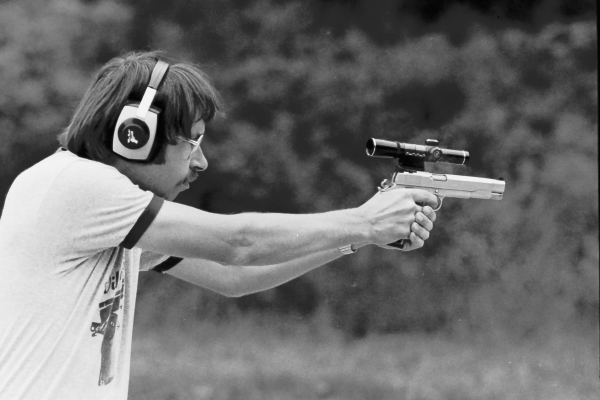
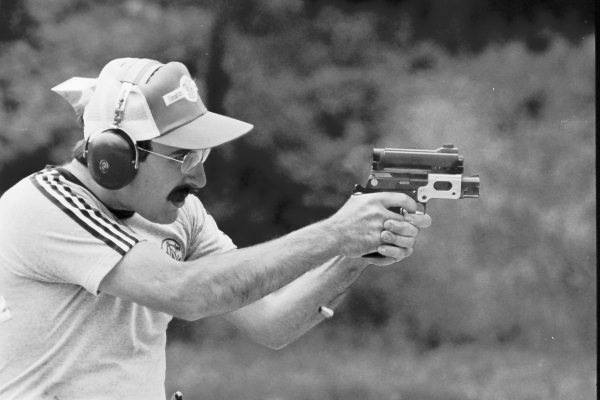
Granted, I cited examples and provided photos from 40 years ago. Over time it’s become increasingly obvious that when it comes to shooting technique, nothing is new and little can be dogmatically called “right” or “wrong.” Aging doesn’t inherently make us better but it certainly deepens our reservoir of experiences to use for intelligent discernment (that’s called “profiling” in law enforcement circles).
Aging is an unusual phenomenon; it mellows bourbon but curdles milk. From what I’ve observed, it does the same to people. At least I think it does. In my case, as I stand on the cusp of my 8th decade, I’ve mellowed socially but curdled politically. This makes it difficult at times for me to know when to offer my opinion and when to simply keep my mouth shut. I know that I’m not alone in this conundrum because every once in a while, I see a name pop up on the internet that I recognize (meaning that they’re most likely long in the tooth) voicing opinions that would be best kept to themselves. Of course, that’s my opinion and since I’m not keeping it to myself, as Doc Holliday said, “My hypocrisy knows no bounds.”
May we all have a Happy New Year, and may Auld Lang Syne keep us hypocrisy-free in the future.
Greg Moats was one of the original IPSC Section Coordinators appointed by Jeff Cooper shortly after its inception at the Columbia Conference. In the early 1980’s, he worked briefly for Bianchi Gunleather and wrote for American Handgunner and GUNS. He served as a reserve police officer in a firearms training role and was a Marine Corps Infantry Officer in the mid-1970’s. He claims neither snake-eater nor Serpico status but is a self-proclaimed “training junkie.”