
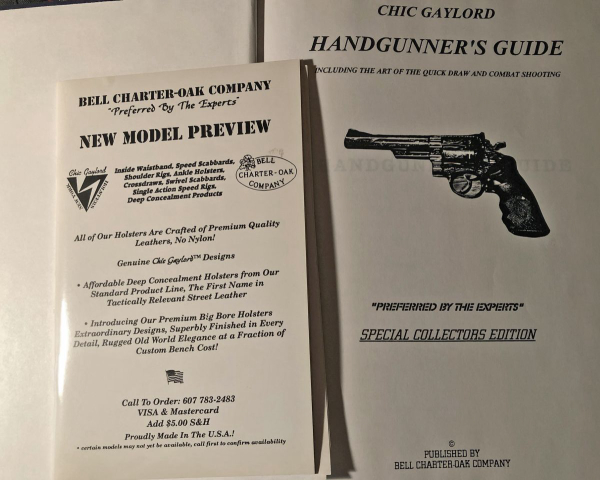
BCO Holsters – Bell Charter Oak – is the home of holsters designed by Charles P. “Chic” Gaylord. I’d had some experience with some of those holsters back when – and wish I still had them. Before anyone cries out that the designs are ‘old-school,’ let me point out that just because something’s new doesn’t mean it’s necessarily better.
Further, just because something was designed in the 1950s doesn’t mean it’s not useful. Besides, elements of the human story are cyclical; what goes around comes around and we’re finding people stepping up to the revolver (BCO has holsters for auto pistols too).
The thing about BCO, Chic Gaylord and B.E. “Lefty” Lewis – proprietor of Bell Charter Oak – is the amount of thought put into the design and execution of the holsters. To get a grip on that, looking at Gaylord’s book, Handgunner’s Guide: including the Art of the Quick Draw and Combat Shooting, is instructive. Reissued in the 1990s by Bell Charter-Oak Company as a “Special Collectors Edition,” it’s a chance to see the reasoning behind the Gaylord designs written by the man himself.
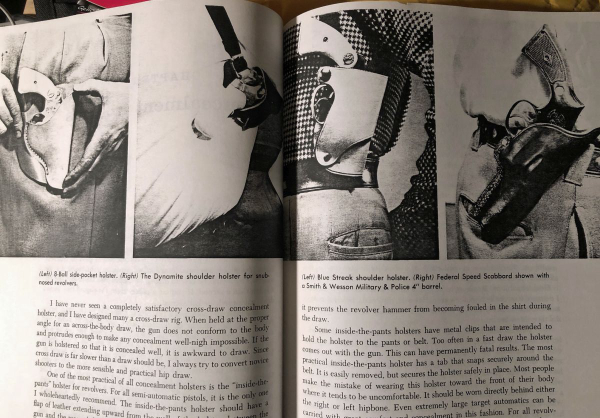
Firearms journalist Rob Garrett shared a document in which he recounted spending some time in an interview with Chic Gaylord before he passed. He got some insight into the man, his life and his holster designs. Perhaps he’ll revisit the topic someday.
How did I get interested? I went to the public library in my hometown when I was a tad. As my interest was in firearms, I found a section that had firearms books.
In those days, it was okay to have gun books in a public library.
The two-most checked out books by me were an early tome by Jeff Cooper and Handgunner’s Guide. Part of the reason I selected them was that the authors didn’t say the same thing. There was some diversity of thought even in those medieval times.
Later, when I’d spent some years putting pen to paper myself, my editor instructed me to check in with Lefty Lewis to see if I could write something up about those holsters. I did, received a reprint of Gaylord’s book, a catalog and the aforementioned product.
The issue for the carry of snub revolvers, in particular, is the center of balance – as pointed out by Michael deBethancourt, current of Snub Noir fame. Longer barrels – slides for auto pistols – can be better and more efficiently carried concealed because of the issue of the center of balance.
Inside the waist, the longer gun is no issue as the clothing covers the barrel/slide. Outside, the longer front section can be pressed upon by the body to force the gripping area into the body. With snubs, this becomes critical.
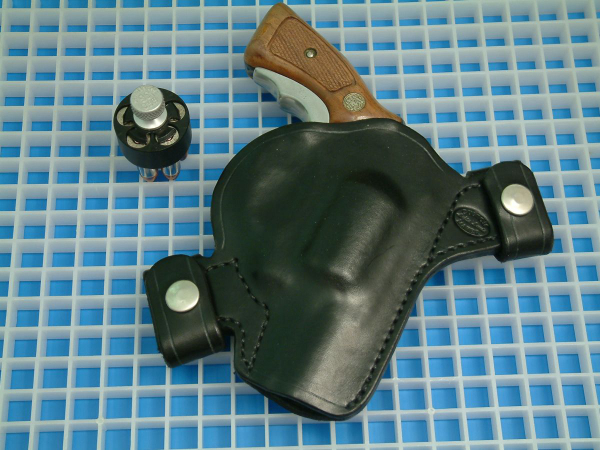
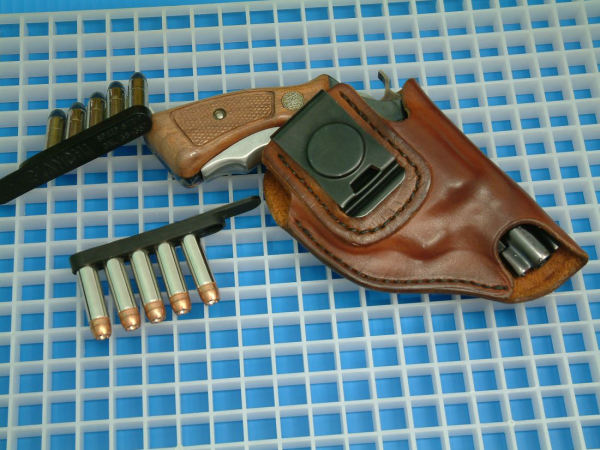
As deBethancourt points out, the rear of the cylinder should be level with or below the top edge of the belt. This can conflict with a proper grip, but ensuring the gun doesn’t ‘tip away’ from the body is critical to keeping the gun hidden. Learning a good “surreptitious” draw is helpful.
Some examples pictured are, sadly, no longer offered.
These include the Bell Charter Oak Charter Jet holster, extreme in how it rides and its rake/tilt. It snaps onto the belt with straps at its front and rear. Need to disarm to go into the post office? Simply unsnap the Charter Jet from the belt and put the gun, holster and all, into your vehicle’s locked container – a handy rig indeed.
Bell Charter Oak also made an “Assist Draw” version of the IWB holster. Looking similar to the old-style clip-on suede holster, the Assist Draw sits very low in the waist, enhancing concealment. The outside of the holster over the muzzle is cut away, allowing the user to put upward pressure on the barrel underlug from outside the trousers to push the gun up for drawing.
Concealment is about compromise, smart design and quality execution. I’ve not dealt with BCO for these many years, but I’m a fan – and I’m happy to find out the company is still open and still making holsters.
The number of options is decreased from years gone by, but they still offer a solid selection. If practical very discreet carry gets your attention – along with some less discreet very fast options – give Bell Charter Oak a look.
-- Rich Grassi